
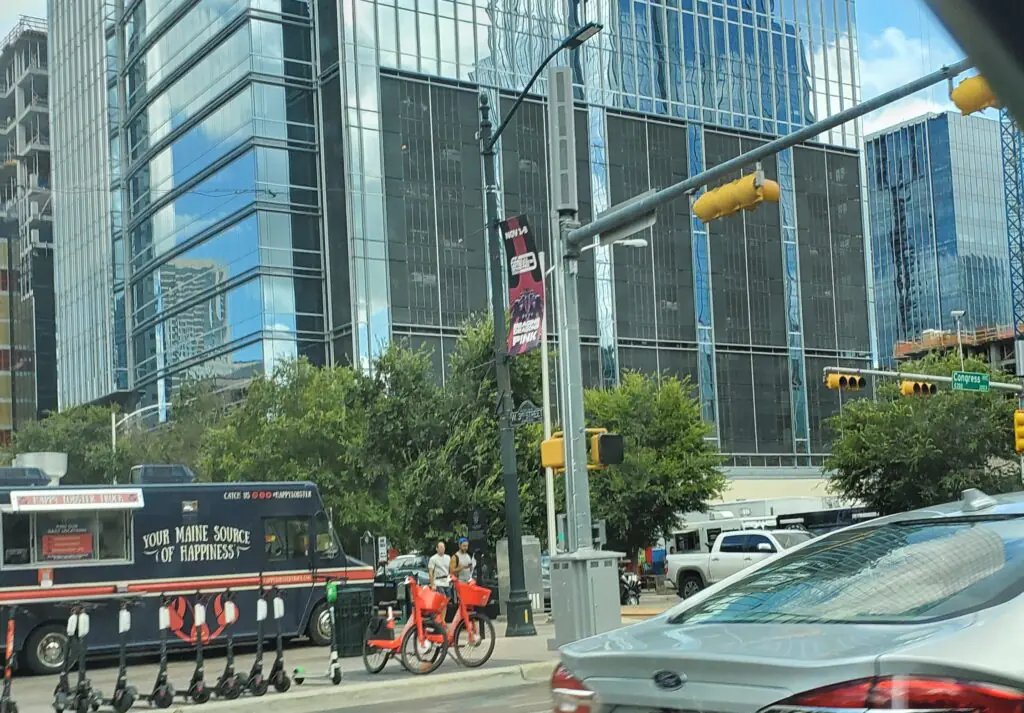
Aeparmia provided engineering and permitting services for several project sites in the Austin Jurisdictions. The scope of work included Surveying and utility locates; Data collections, jurisdiction requirements research and records research; Utilities coordination and conflict analysis; Utilities design and construction drawings for power and fiber routes per COA Utilities Criteria Manual (UCM), Transportation Criteria Manual (TCM), and Code of Ordinances, complying with TX SB 1004, Ch 284, Sec 284.003; Structural analysis ; Permitting services; and Bidding phase and construction phase services such as RFIs.
In one case, the small cell’s original location was discussed with the City in 2018, and an optimal solution was provided to install a stand-alone pole which was approved and permitted. The permit was revoked due to TX S.B. No. 1004, Sec. 284.104 (a) (1), and City requested to resubmit the design for this site, therefore, we went back to the original location because the RF Engineer is limited to a particular distance for the same site ID. Due to heavy trees we are unable to relocate to the nearest or adjacent lot line to the North of our current site, we were rejected for placing a new node, thus we are unable to relocate this pole reasonably as we can’t place it in front of a property. In order to use the original site location, we would need to replace the pole and install small cell equipment on it. The constraints are the close proximity to the driveway, close proximity to a palm tree, and close proximity to existing water meter. The solution for these constraints was to remove the Palm Tree, install a new pole right next to existing where would still be clear from the driveway, transfer all wire attachments to it, place the required power utility’s pull box. The remaining issue is the clearance from existing water meter, which is being resolved by coordinating with carriers and water department. Aeparmia’s engineer developed alternate solutions and recommendations for the Utility to review. Aeparmia’s focus is working with the involved parties to resolve the issue in a timely manner, bringing in the civil engineering experiences to solve infrastructure problems that carriers weren’t aware of, nor anticipated. The lesson learned through this case is that if Carriers provided feasible sites and avoided sites with conflicts, then the design and permitting processes run smoother and faster, thus we believe that feasibility phase is critical for the success of the small cell application process.